Affichage des articles dont le libellé est liquidateurs. Afficher tous les articles

lundi 12 décembre 2016

Humains vs Irradiation, jusqu’où la science est-elle compétente ?


(45'25'' Jp st Fr) - Télécharger la vidéo (380 Mo)
(Nota : faites défiler les pages jusqu'en bas pour les liens de téléchargement)

N'hésitez pas à "liker" la vidéo sur YouTube en cliquant sur le pouce bleu et à la partager ainsi que cet article pour améliorer leur visibilité, merci :)


Transcription en français

Cinq ans après, quelles sont les conséquences de la catastrophe nucléaire de Fukushima sur les humains, la faune et la flore ? C'est l'une des questions que pose cette émission de la chaîne de télévision japonaise NTV (Nippon TV), diffusée le 13 mars 2016.

Quels sont les effets sur les humains de l'irradiation à faible dose, à moins de 100 mSV ? Pourquoi les opinions sont-elles divisées à ce propos parmi les spécialistes ? Des scientifiques et d'anciens travailleurs du site de la centrale nucléaire de Fukushima Daiichi victimes de leur exposition à la radioactivité témoignent.


Participants :
  • Haruo Kurasawa, journaliste scientifique
  • M. "A", habitant à Iwaki, 49 ans, dose reçue 50 mSv
  • M. "B", habitant à Sapporo, 53 ans, dose reçue 56 mSv
  • M. "C", de Kitakyushu, 41 ans, dose reçue 19,8 mSv
  • Dr Masamichi Chino, créateur de SPEEDI
  • Hiroaki Koide, Prof. assistant à l'Institut de recherches du réacteur de l'université de Kyoto
  • Noboru Sakurai, chef du groupe de biotechnique appliquée, Centre de recherches industrielles municipal de Tokyo
  • Nagashima, chercheur du groupe de biotechnique appliquée, idem
  • Dr Masamichi Nishio, directeur honoraire du Centre anti-cancéreux d'Hokkaido
  • Prof. Toshihide Tsuda, épidémiologiste et professeur à l'université d’Okayama
  • Prof. Tatsuhiko Kodama, spécialiste de la radiothérapie par isotopes, université de Tokyo
  • Dr Keiichi Nakagawa, médecin radiologue à l’université de Tokyo
  • Prof. Joji Otaki, université de Ryukyu
  • Prof. Shin-ichi Hakimoto de l'université d'Hokkaido
  • M. Watanabe, chercheur en chef, Laboratoire général de radiologie
  • Prof. Keiji Okada, de l’université d'Iwate
  • Prof. Shin-ichi Hayama, de l'Université vétérinaire et des sciences de la vie du Japon
  • Prof. Masamichi Nakajima de l'université du Tohoku
  • Tetsuji Imanaka, Prof. assistant à l'Institut de recherches du réacteur de l’université de Kyoto
  • Prof. Tomotaka Sobue, de l’université d’Osaka, spécialiste de la médecine environnementale
  • Shigenobu Nagataki, Prof. émérite à l’université de Nagasaki, président de la Fondation pour la recherche sur les effets des radiations
  • Susumu Shimazono, ancien professeur à l’université de Tokyo, spécialiste de l'étude
    des religions, d’éthique et de philosophie

Merci à Kazumi Nakao-Goto pour sa traduction française, ainsi qu'à Pierre Fetet du Blog de Fukushima pour sa relecture. Mise en forme finale et sous-titrage par mes soins.

Sources :


https://youtu.be/LJzaVvf2qbA
http://www.ntv.co.jp/document/backnumber/archive/31171the-vs.html


En savoir plus :

Publications scientifiques du Dr Masamichi Chino
Livre du Prof. Hiroaki Koide
Publications scientifiques du Dr Masamichi Nishio
Publications scientifiques du Prof.Toshihide Tsuda
Publications scientifiques du Prof. Tatsuhiko Kodama  
Publications scientifiques du Prof. Keiichi Nakagawa  
Publications scientifiques du Prof. Joji Otaki
Publication scientifique du Prof. Shin-ichi Hakimoto (En)
Publications scientifiques du Dr Yoshito Watanabe (En)
Publications scientifiques du Prof. Keiji Okada (En)
Publications scientifiques du Prof. Shin-ichi Hayama (En) 
Publication scientifique du Prof. Tetsuji Imanaka (En) 
Publications scientifiques du Prof. Shigenobu Nagataki

Meet the nuclear cattle of Japan - CNN (En)
Radiation Reloaded: Ecological Impacts of the Fukushima Daiichi Nuclear Accident 5 years later - Greenpeace.de (En) 
This is what radiation can do to human body (En) (Victime de l'accident de Tokai-mura) 


jeudi 14 mai 2015

"Tchernobyl : Conséquences de la catastrophe sur la population et l’environnement" EN FRANÇAIS

IndependentWHO vient de publier la version française de cet ouvrage important :


Après la publication originelle de Saint-Pétersbourg en 2007 et celles de New-York en 2009 par l'Académie des Sciences de NY, celles de Kiev en 2011 et Tokyo en 2013, c'est la cinquième édition de cet ouvrage, actualisée autant que possible avec les nouvelles données disponibles au fil du temps, et confirmant l'importance énorme des conséquences de la catastrophe pour la santé humaine et l'environnement.

Extrait de la présentation par IndependentWHO : "Six décennies de dissimulation institutionnelle, internationale et à un niveau élevé, a privé le monde entier d’une information médicale et scientifique particulièrement importante sur les conséquences sanitaires des activités nucléaires industrielles et militaires.
Ce livre rend disponibles d’énormes quantités de preuves issues d’études indépendantes entreprises dans le monde entier et dans les pays les plus touchés, des données uniques et fiables qui ont été ignorées et continuent de l’être par l’organisation mondiale de la santé. Il  fournit une vision exhaustive des dimensions réelles de la catastrophe de Tchernobyl sur la santé et l’environnement."


Il est également possible d'acheter une version papier de ce livre, je vous engage à consulter l'article original sur le site d'IndependentWHO pour en savoir plus à ce sujet.

Merci aux auteurs, et à l'équipe française pour cet énorme travail, qui a rendu possible l'accès aux francophones de cet ouvrage unique :

Line Aldebert (traduction, coordination, relecture)
Alain Bougnères (mise en forme du document)
Marie-Élise Hanne (participation à la traduction de la Partie III), médecin biologiste
Thierry  Pain  (traduction  et  relecture),  traducteur  professionnel,  membre  d’Enfants  de  Tchernobyl Belarus,  botaniste  amateur  impliqué  dans  la  sauvegarde  de  stations  d’Orchidées  et  l’éradication d’espèces invasives en région parisienne.


Nota : La version de 2009 de cet ouvrage en langue anglaise peut être téléchargé ICI.

~ ☢ ~

En complément, vous pouvez voir ou revoir l'intervention du Pr Alexey Yablokov sous-titrée en français, intitulée Leçons de Tchernobyl, lors du symposium d'Helen Caldicott à New-York en 2013 :


(22'48'' En st Fr) - Télécharger la vidéo (153 Mo)


Également disponible sur ma chaîne, le numéro de mars 2011 d'Enviro Close-Up avec Karl Grossman et Janette Sherman, intitulé Tchernobyl, un million de victimes :


(28'59'' En st Fr) - Télécharger la vidéo (197 Mo)


mercredi 1 janvier 2014

FULL TYVEK JACKET - To the workers of Fukushima


(Version française ici) - (Sorry for mistakes, English is not my mother language...)


To the workers of Fukushima.

The first to intervene at the most terrible moments of the nuclear disaster.
Those who - day after day - are up against
an ever-worsening situation.
Those who will have to replace them
for many years to come.
To their families and loved ones.

This is a message of gratitude and sympathy from France.

You may not be able to rely on your employers or your political leaders to treat you properly, but this doesn’t mean you are alone, iscredited, facing the hard to overcome problems you have to deal with.

This may only be a meagre consolation to you, but many thousands of kilometers away, complete strangers, ordinary citizens like you are thinking of you and are grateful for your courage and your dedication.

You are important people who deserve every respect, given the responsibilities you are constantly shouldering and what you are accomplishing, without recognition or reward.

One can't blame the worker who unplugged the wrong pipe, pressed the wrong button or caused a tank to overflow, because of a lack of training, precise instructions and means of control.

One can't blame the worker who falls into depression when he is confronted by difficult working conditions that endanger his health and his life?

There are probably, throughout the world, thousands if not millions of people like us who are on your side and count on you, who offer you their trust and moral support, and who don’t forget you exist.

We don’t know you personally, but like you, we are human beings and citizens of the Earth. We are aware of your difficult position, we cannot do much to help you, but we want to say thank you for what you do, thank you for the risks you are taking for us all. You have our heartfelt support.

Thank you, "Fukushima 50" and all the brave people who from the very beginning of the disaster did not hesitate to risk their lives to prevent an even more dire situation.

Thank you to all these people whose name will never get mentioned but who contribute each day to the colossal task of keeping the radioactive peril at the Fukushima plant in check.

May our moral support and our thoughts reach you, your families, and the loved ones of the victims who have lost their health and their lives in this battle.

~ ☢ ~

Here is this same text in PDF, translated into several languages. My goal is that the Japanese message can reach some Fukushima workers. Post this text, pass it on, so it has a chance to reach its recipients. (Please share the links below, not the files themselves or their direct links, so I can keep visibility on their attendance.)

Japanese
福島原発で働く皆さんへ 
German
An die Arbeiter im Atomkraftwerk Fukushima
English
To the workers of Fukushima 
Spanish 
A los trabajadores de Fukushima 
Esperanto
Al la laboristoj de Fukushima
French 
Aux travailleurs de Fukushima
Italian 
Ai lavoratori di Fukushima 
Dutch
Aan de werknemers van Fukushima
Portuguese
Aos trabalhadores de Fukushima
Russian
Работникам на Фукусиме
Other
It's up to you ...


~ ☢ ~

The title of this article, "Full Tyvek Jacket", probably reminds something to many of you. This is not coincidence.

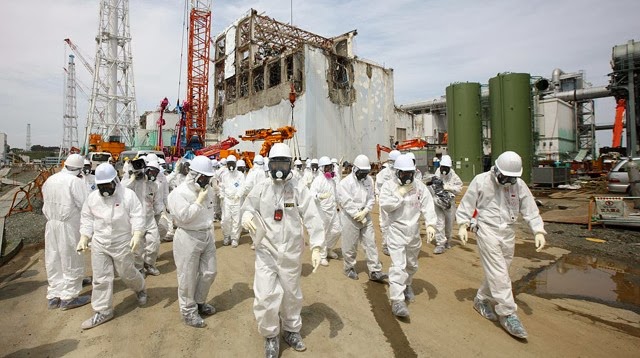
Tyvek is a material made from non-woven polyethylene fibres, a fortuitous discovery of the DuPont company in the 1950s. It is the constituent of white or sometimes blue protective suits, intended to be worn by all the workers involved on the Fukushima Daiichi site and decontamination sites in controled areas. This type of combination is widely used in many industrial or craft activities as disposable protective clothing against dirt.

For what concerns us, they therefore mainly protect workers from contamination by radioactive dust. But absolutely not against penetrating radiation, gamma rays or neutrons beams. Against these risks you should have lead or tungsten based composites, used for example at Chernobyl or Fukushima, by some very exposed stakeholders during the cleaning work on the reactor 3 building.

They do not protect either against risk caused by faulty adjustment of all protective elements of the outfit, due to missing or insufficient instructions, or inadequate equipment parts. Be remembered for example of the workers irradiated in March 2011 in the reactor 3 building unit flooded with highly contaminated water
they waded, having seeped between their low boots and the ill-fitting outfit. On the other hand, it should be noted that "for photos", where their colleagues hiding them behind a tarp during their evacuation to receive care, everyone seems well sealed and stuck around. Or almost... 

So here is the only armor against radiation available to the vast majority of workers in Fukushima: polyethylene overalls. Full tyvek jacket ...


Russia Today recently published a short report on the conditions of workers in charge of the post-Fukushima rehabilitation work. Here it is with French subtittles. It includes Tomohiko Suzuki, the courageous investigative journalist who worked clandestinely in Fukushima for a month and a half during the summer of 2011, and has published a book titled "The Yakuza and the nuclear industry."


(3'30'' En st Fr) - Download the video (24 Mo)


Although a bit long, I suggest you to look at the following conference held in December 2011, in which Mr. Suzuki describes his experience at the Fukushima plant, with some photos and video footage taken on the spot . The two main themes are:
- The state of the plant, despite the official declaration of "cold shutdown," the risks to workers and the shortcomings of TEPCO and the Japanese government.
- Involvement for many years of the Yakuza mafia organizations in the Japanese nuclear industry.


(1h42'03'' Jp + En st Fr) - Download the video (700 Mo)


Now here is the testimony of some Fukushima workers who contacted the ZDF (German TV) studios in Tokyo in October 2011: "Those that are often called heroes, those who do the cleaning, gave their version of their severe work conditions without having any real idea of radioactivity doses there. Even if nuclear disaster is out of the head of most people, for those who work there, it continues ..." (German & French language only)


(8'16", De st Fr) - Download the video (57 Mo)


Here is a French video by BFMTV, published in March, 2013: "They are sometimes called liquidators, they are the workers at the Fukushima plant in Japan. Two years after the nuclear disaster, they are still likely to work on the site, in harsh conditions. In their white overalls, mask face, they are 3,600 working night and day to stabilize the damaged power plant. "


(1'20", Fr) - Download the video (60 Mo)


The months and years pass, very little change. Now back to more than 40 years ago, with the uplifting documentary by N. Röhl, "Nuclear Ginza", where he gives the word to several victims, sent to be irradiated without protection or training in the most dangerous areas, and to the parents of a less than 30 years worker, who died. I've already posted an article there about that one year ago. If not already done, go read it, review this video. This is also the nuclear world, in the beautiful nation of Japan, moving towards a bright future ...


(25'36", En st Jp + Fr) - Download the video (60 Mo)


Here is now the testimony of a reader, Satoko, that she send me in English after the original publication of this article, and allowed me to reproduce here:

"My parents who live a small town facing pacific in Hokkaido, Japan, once had an opportunity to host a homeless person in their house. He was looking for a one night shelter in the small town in Hokkaido with no money. The old man used to be working in various power plants in Japan and when he would reach his maximum annual dose of radiation he would leave the site and start travel around Japan. He ended up in Hokkaido at that time after working somewhere and found himself with no money. After one night he left for Aomori, the northern tip of Honshu island, with some money my father gave for train fare. I suppose many workers have been living like the man, working in various power plants sites in Japan since the very beginning of Japan's nuclear history. They are not the people who are rightly protected and well paid for their dangerous nature of the work. It is the shadow of the nuclear history of Japan and I am glad you mentioned about them in your blog!
I just asks my mother who is now with us about the old guy they hosted. Apparently the man came to the local catholic church to look for a shelter, which means he knew very well that religious temples and churches were likely to give money or shelter for him. But people in the church didn't do so and called my father to deal with him (my parents are catholic). My father took him to the house and offered one night shelter, with dinner and drinks and bath. My mother says they have already hosted many people (mostly hitchhiker on the streets) at their place so didn't surprise her that time, too. My father is really a strange kind…. The man said that he had an apartment in Tokyo, but they didn't buy the story, as well as his claim that his money had been stolen. He would stay in one place and work, earn money, and hitchhike all around Japan. I think many construction workers are temporary sub contractors, and sometimes employers give food and shelter (of course they cost money, subtracted from the daily pay) for those in need. The man my parents hosted was probably one of those workers.
Now I have seen some advertisement for recruiting workers and they are like 13,000 yen a day, but I don't think it it true. Workers usually have to pay for contractors fees, a bed and food, even for the health check ( I read it in the article I posted in the FB page). At last the money they receive should be much lower than the advertised. I remembered the story somehow because it happened after 3.11. It was kind of interesting".


I think it would be unfair not to mention also those which are often early in the frontline of disasters, the firefighters, and the military. Certainly, they are more likely to chose their profession without being picked up in some shallows by the Yakuza. But whether in Ukraine or Japan, how many of them paid with their lives for their willingness to fight a battle in which they were not prepared, and brought relief to others? We'll never know, it's not in the interest of any government or authority to recognize and disclose exactly such kind of things when it comes to nuclear power.

However, here is a testimony about the death of a member of the special rescue unit of firefighters, who has not been officially confirmed or reported in the mainstream media. It includes Taro Yamamoto, who had not yet paid policy. Since that, some also tries to make him pay a high price for the truths he tries to highlight ...


(4'33", Jp st Fr) - Download the video (60 Mo)


Here is also an American channel PBS documentary, "Inside Fukushima's meltdowns", in English, which pays tribute to these brave men.
The English transcript is available following this link.


(53'08'' En) - Download the video (751 Mo)


It seems difficult for me to finish this article, yet dedicated to the workers of Fukushima, without a mention to France. Can we think that in France, the situation of nuclear workers is better? In france, it's not the mafia that provides all-comers intermittent to nuclear industry. And here, no Fukushima-like disaster yet. But there is much more to say on the subject, which deserves a specific article.

Here are just "The nuclear convicts", a photo-montage made ​​in August 2011, based on pictures by Vincent Capman. He also worked with men he photographed in Cattenom and Paluel French NPP in 2008 and 2009. He shared their lives, their workdays, their rest periods.


(3'43", Fr) - Download the video (25 Mo)

~ ☢ ~


One last question :

Is it what you want
for your children too,


"full tyvek jacket" ?


~ ☢ ~  

To come back to the message for the workers, I would be very happy that other people or other groups took up this idea, and also express their support for those fighting on the battlefield of Fukushima, for all of us.Post this message on your website or blog, please contact us to translate it into other languages ​​and for inclusion in the list of participants.
Write your own support  message if you prefer, and distribute it as well.
You can also write a traditional letter, here is the mailing address of the "rear base" of workers at J-Village. It features Japanese mention "To the Fukushima workers". The easiest way is probably to print it directly or stick it on the envelope.

Don't forget that the majority of recipients only read Japanese. But there are drawings, symbols, which do not need to understand a foreign language.


〒979-0513福島県双葉郡楢葉町大字山田岡字美シ森8Jヴィレッジ内
福島復興公社
福島第一原発の作業員の皆様へ

Fukushima Revitalization Headquarters at J-Village
8, Utsukushi-mori, Yamada-oka aza
Naraha-machi oaza, Futaba-gun
979-0513, Fukushima
Japan

Please Check with your local post office for postage fees.

If we multiply enough and relay this movement of fraternal support, if enough media to echo, then maybe this will encourage Japan to make a move for these brave men. One can always dream ...


~ ☢ ~  

Acknowledgments and credits:


Big thanks to all those without whom I couldn't have finally give life to this project.
Thank you of course to the participants, which help spread this message, and I have been an indispensable aid among other translations.
Thank you to Cathy, Janick, Pectine, Odile, SB, Akio, Georges Laurent, Pierre, Pierre R. Dandoy, Paolo, the team from Afaz site. I hope not to forget anyone, if that's the case, let me know.

Special thanks to those who preferred to remain "anonymous valuable contributors" for their decisive participation, they will recognize themselves.

Special Report: Japan's homeless recruited for murky Fukushima clean-up
Appreciate Fukushima Workersthe initiative of a former worker of Fukushima in assisting other workers. (Jp) 
Former TEPCO employee seeks donations for downtrodden Fukushima workers
Réservoirs de Fukushima : fuyards et construits par des travailleurs illégaux (Reuters UK traduction Google)
Press Release (Nov 29,2013) Exposure Dose Evaluation of the Workers at Fukushima Daiichi
Nuclear-News, TEPCO-Workers deaths are not reported 報道されない原発作業員の死亡について
Riva Press, photographies de Vincent Capman

The Guardian, Life as a Fukushima clean-up worker – radiation, exhaustion, public criticism
PBS, For Fukushima Workers, Cancer Isn’t the Only Health Threat
The Telegraph, How the Yakuza went nuclear
Kibo-promesse, Yakuza et nucléaire au japon

Russia Today, Atomic Mafia? Yakuza cleans up Fukushima, neglects basic workers' rights
CCTV English, workers say decontamination work ineffective
Reuters Insider, Help Wanted: Must be willing to work at nuclear ground zero
Japanfocus, Nuclear workers down and out at Fukushima
Enenews, ‘Nuclear Slaves’ at Fukushima
Enenews, Multiples cancers for ex-Fukushima worker

Reuters, Help wanted in Fukushima: low pay, high risks and gansters
Témoignage original de Satoko en anglais
原発作業員の労働状況は以下の記事をご参考に
Enformable, Chairman of Japanese nuclear regulator blames declining worker morale for Fukushima leaks and problems
Nobody, pointing a finger at Fukushima 1 webcam

The Independent, 'I am one of the Fukushima fifty'
BBC, Why Japan's 'Fukushima 50' remain unknown
The Guardian, Fukushima 50: 'We felt like kamikaze pilots ready to sacrifice everything'
Wikipedia, Fukushima 50 (En)
Wikipédia, Les cinquante de Fukushima
Agoravox, Fukushima : Les travailleurs se cachent pour mourir

Courrier International, Les ouvriers de Fukushima "invités" à truquer leurs dosimètres
Europe 1, Le "héros" de Fukushima est mort
Gen4, L'incroyable histoire des "50 de Fukushima" 

Kibo Promesse, les enfants japonais parlent de Fukushima
Culturebox, Fukushima à travers 400 dessins d'enfants japonais 


Hymn to The Fukushima 50 - a Tribute by Julius Dobos


----------------------------------------------------- Participants ------------------------------------------------------------

Franck
Georges
Odile
Pectine
Pierre
4 from AFAZ
Paolo
Citizenperth
Legion Network CH
Philippe Hillion
     
〃              〃


—————————————————————————————————————————————————— Kna60 sur YouTube

—————————————————————————————————————————————————— Kna60 sur Dailymotion

—————————————————————————————————————————————————— Kna60 sur Vimeo

Fukushima - Que savaient-ils et quand ? - A. Gundersen 11.03.13 from Kna60 on Vimeo.